

Heat as a Service and Steam as a Service: How can industrial heat and steam be purchased as a service?

An industrial plant needs a reliable supply of heat or steam to produce. But generating that supply does not have to mean financing, owning, operating, and maintaining the equipment that produces it.
With Heat as a Service (HaaS), the industrial consumer purchases the industrial heat it needs, and the provider takes care of the generation system up to the agreed delivery point. When the process requires that heat to be supplied specifically as steam, this is known as Steam as a Service (SaaS).
SaaS applies both when steam is used directly in the process and when it acts as the medium for supplying the required heat. The service is defined around the plant’s needs: steam quantity, temperature, pressure, and availability.
Instead of purchasing a new generation system, the company purchases the supply it needs to produce.
How does Heat as a Service work?
Heat as a Service (HaaS) is part of the broader Energy as a Service (EaaS) model. Instead of purchasing the assets that generate the energy, the consumer contracts for the supply it needs.
In HaaS, that supply is thermal energy. The provider finances, designs, builds, owns, operates, and maintains the generation system up to the delivery point agreed with the plant. From that point onward, internal heat distribution and its use in the process remain the responsibility of the industrial plant.
Within HaaS, Steam as a Service (SaaS) applies the same structure when the contracted thermal energy must be delivered as steam.
The relationship between the three models can be summarized as follows:
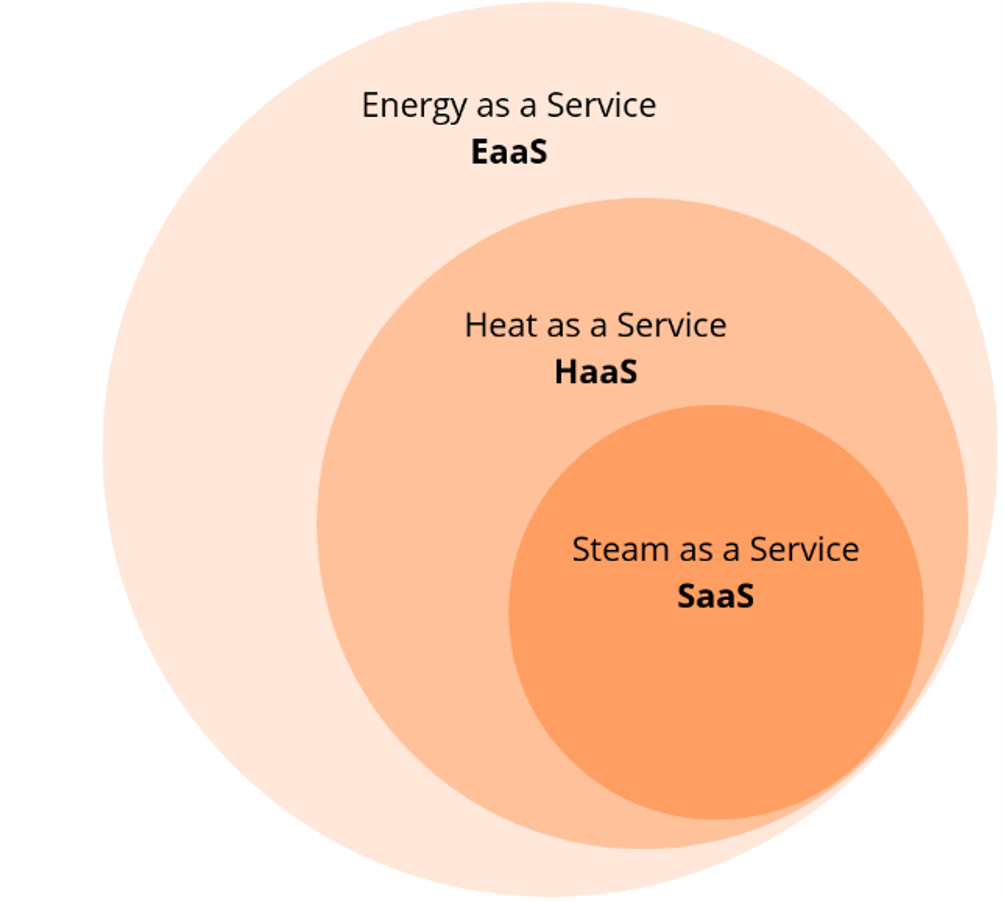
Figure 1. Relationship between Energy as a Service (EaaS), Heat as a Service (HaaS), and Steam as a Service (SaaS).
The supply is normally contracted through a Heat Purchase Agreement (HPA). Its logic is similar to that of a Power Purchase Agreement (PPA): while a PPA sets the conditions for electricity supply, an HPA does so for thermal energy supply.
What if steam is required?
With Steam as a Service (SaaS), the contracted supply is industrial steam under the conditions required by the process: quantity, pressure, temperature or quality, and availability.
A single plant may have demand at different temperatures and pressures. The service is sized for those profiles and delivers steam at the agreed point; from there, internal distribution and use are the responsibility of the plant.
The supply can be measured and billed based on the quantity of industrial steam delivered, for example per tonne of steam, depending on the contract structure.
SaaS therefore makes it possible to contract directly for steam supply for industrial processes, rather than for the equipment and energy needed to produce it.
Is SaaS a supply model rather than a technology?
Steam as a Service (SaaS) defines how industrial steam supply is contracted, not how it must be generated.
At FersiSolar, concentrated solar thermal (CST) is our primary technology for producing industrial heat with solar energy when it is the solution that best meets the plant’s needs.
The system can incorporate thermal energy storage (TES) to adapt solar production to the plant’s consumption profile.
CST can cover more than 50% of industrial thermal demand. When the goal is to reach up to 100% renewable energy supply, it is combined with the additional technologies that best match the demand, such as electric boilers, heat pumps, or other renewable sources.
The configuration is defined according to the steam to be delivered: quantity, temperature, pressure, and consumption profile.
How is Steam as a Service contracted?
Steam as a Service (SaaS) is structured through a long-term supply contract, such as a Heat Purchase Agreement (HPA). The customer contracts for the industrial steam it needs, while the investment and generation assets remain with the provider.
The HPA defines steam quantity, pressure and temperature, availability, delivery point, metering, price, and minimum contracted consumption. Steam can be measured and billed based on the quantity delivered – for example, per tonne – depending on the contract structure.
What changes compared with generating steam using owned assets?
With on-site generation, the plant invests in the equipment and assumes responsibility for its operation and maintenance. It must also have the internal resources needed to maintain the industrial steam supply throughout the life of the system.
With Steam as a Service, those functions pass to the provider up to the delivery point. The customer does not make the initial investment in the new generation assets and pays for the steam supplied under the conditions established in the HPA. The model converts an investment in energy infrastructure (CAPEX) into a cost associated with the contracted supply (OPEX).
This allows the company to keep its capital and technical resources focused on its production activities while the provider takes care of the system that generates the steam. In an industrial heat decarbonization project, it also avoids the need for the customer to develop internally the capabilities required to finance, design, build, operate, and maintain a new renewable generation solution.
The plant continues to control its process and internal distribution network; what it outsources is the generation and delivery of the contracted steam.
When does Steam as a Service fit?
Steam as a Service can fit plants with significant and stable industrial steam demand, especially when they are seeking to decarbonize industrial heat through a long-term contracted supply.
It does not require all demand to be uniform. The service can cover different temperature and pressure levels and adapt to variable consumption profiles.
Evaluating the project requires specific data: steam consumption, temperature, pressure, hourly profile, existing equipment, and available space.
What is Steam as a Service with FersiSolar?
The main activity of an industrial plant is production, not generating its own energy. FersiSolar offers Steam as a Service so that the customer purchases the kWh it needs in the form of process steam, without investing in or operating the assets that generate it.
Based on the plant’s demand, we determine how to structure the service and what combination of CST, thermal energy storage (TES), and complementary technologies can provide the required renewable energy supply.
The solution includes financing, engineering, construction, operation, and maintenance of the system up to the agreed delivery point.
Sources and References
WBCSD — Heat-as-a-Service in Action: Insights from Early Renewable Heat Projects
Renewable Thermal Collaborative — Heat as a Service (HaaS)
Sirris — Decarbonize Heat and Steam with Thermal Energy Storage
Iberdrola España — Bayer: Electrification and Decarbonization of Industrial Steam Production


