Solar Industrial Heat

We have often discussed the importance of decarbonizing process heat in industry and argued that concentrated solar thermal energy could play an important role in this. But how are fossil fuels actually replaced in practical terms? In this text, we dive into the topic.
Above is the schematic that will guide us. We will focus on a case in which we provide industrial heat in the form of steam at 180°C and hot water at 85°C. Temperatures such as these are typical for the food industry and are the focus of different industrial decarbonization projects. For example, in Seville, parabolic trough collectors produce pressurized hot water at a temperature of 210°C, while in Finland, an electric system at the Herkkumaa Oy plant produces steam at 180°C. Ideally, the system will provide heat at two different temperatures to achieve the highest possible energy efficiency.
Heat Generation
We start with heat generation, for which we use parabolic trough collectors (PTC) or linear Fresnel (LF) collectors. Both are linear concentrating solar technologies that work by reflecting solar radiation towards a receiver tube through which a thermal fluid flows. In the case discussed in this text, where we would like to produce steam at around 180°C, the working fluid would be pressurized water.
Water enters the field at around 95°C, and the field heats it to 245°C (we will discuss later why 245°C rather than 180°C). At higher temperatures, thermal oils would be required, but at such relatively low temperatures there is no problem using water, which is cheaper and easier to operate.
Parabolic trough collectors (Figure 1) use curved, parabolic-shaped mirrors along a longitudinal axis. These mirrors track the movement of the sun throughout the day and concentrate solar radiation onto a focal line where the receiver tube is located. This tube is covered by a glass envelope to reduce thermal losses and contains the water being heated. The solar field would consist of rows of collectors that heat the water to the desired temperature. Adding more rows in parallel increases the system’s capacity. Compared with linear Fresnel collectors, PTCs are more efficient at converting solar energy into heat and therefore require less space to provide the same capacity.
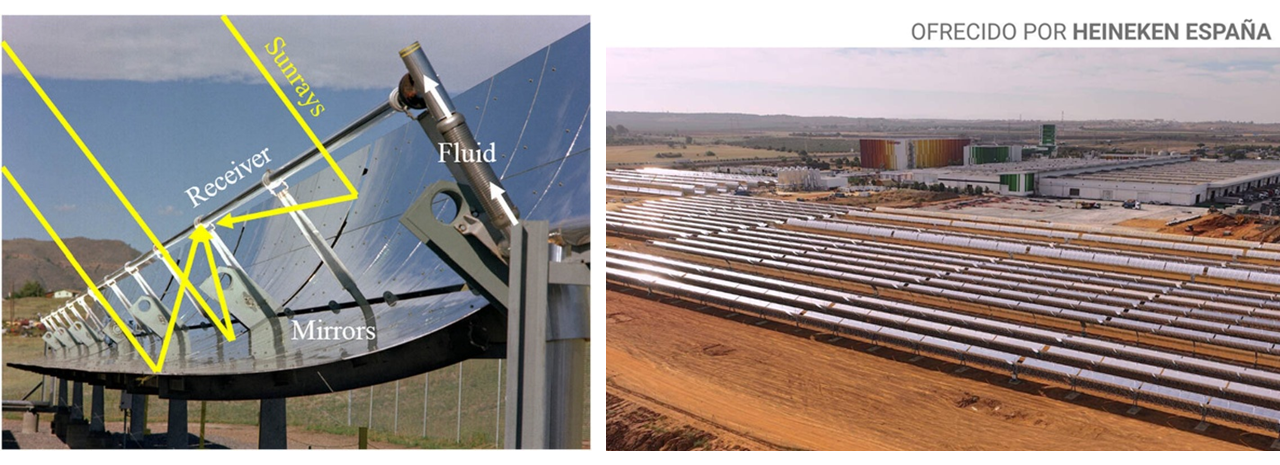
Figure 1: Parabolic trough collector (left) and solar field of collectors (right)
In contrast, linear Fresnel collectors use multiple flat or slightly curved mirrors arranged in parallel rows on the ground. Each mirror is independently oriented to reflect sunlight towards a fixed receiver tube located on an elevated structure. Although solar concentration is not as precise as with parabolic troughs, Fresnel systems have lower material costs and a lighter design, allowing them to be integrated even into industrial plant rooftops.
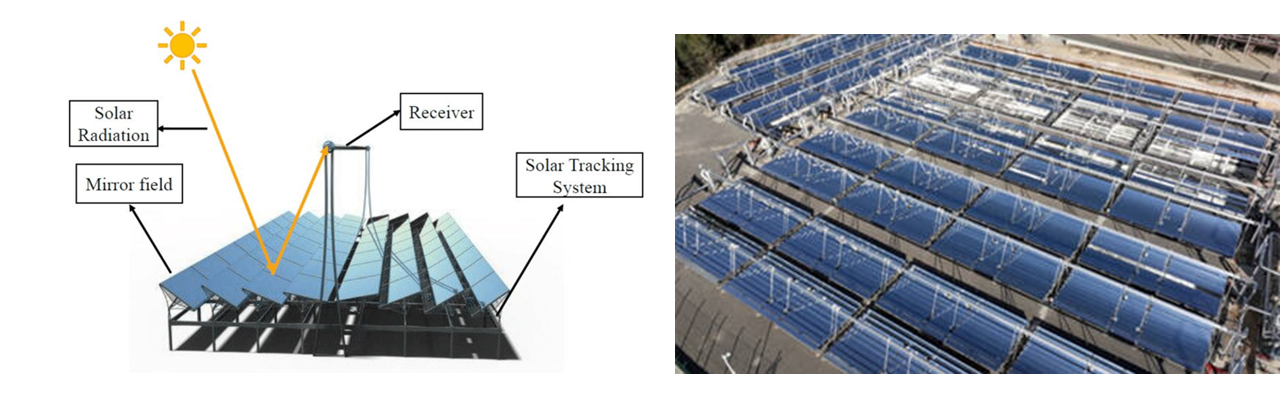
Figure 2: Linear Fresnel collector and collector field
Before closing this section, we should not forget that the solar field could not economically provide 100% of the required heat. Another system operating in parallel with the solar system is needed and can be activated whenever solar thermal energy is insufficient. This could be the fossil fuel boiler that was replaced when the solar thermal system was installed, in order to avoid additional costs, or it could be an electric or biomass boiler to achieve full decarbonization.
Ultimately, solar thermal energy is one of the tools available to reduce the use of fuel oil and natural gas in industry and lower its carbon footprint, but it is not the only one. These other renewable energy sources can be used in conjunction with solar thermal energy in cases where there is limited space available near the plant or where solar irradiation is low.
Storage System
Once we have generated the heat, we need to store it until the appropriate time for use. The simplest approach would be to have a well-insulated tank and store the pressurized water coming from the solar field directly in it. This avoids the need to install a heat exchanger to transfer heat from the water to the material used by the Thermal Energy Storage (TES) system.
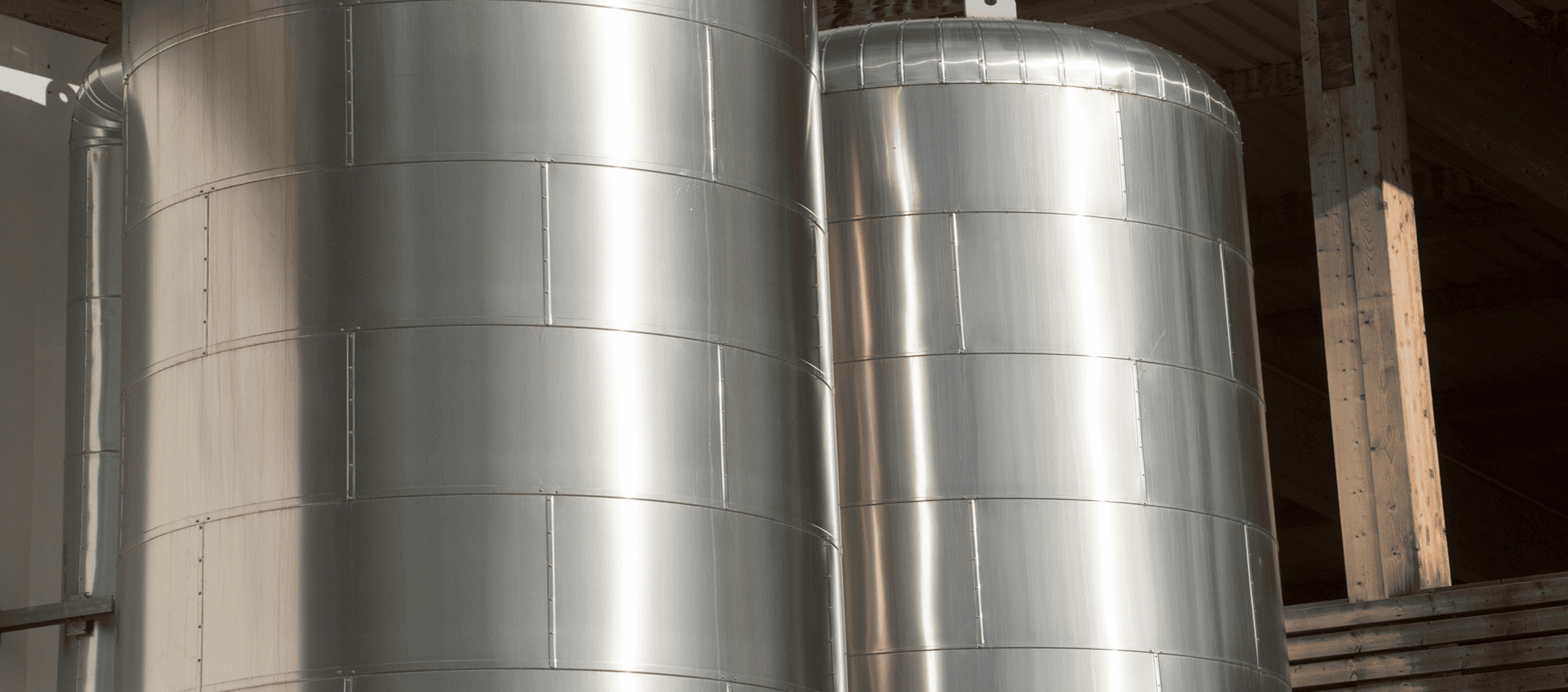
Figure 3: Pressurized water thermal energy storage tanks
So why do we produce water at 245°C? First, if we need to provide steam at 180°C, it is important to have a higher temperature in the TES to ensure that we can always extract at least 180°C, even when the solar field has not been operating for some time and the temperature in the tank has dropped somewhat.
Second, when extracting heat from a material by cooling it, the amount of energy depends on the difference between the initial and final temperatures (Thot – Tcold). If Thot increases by 70% while Tcold remains unchanged, the same amount of material could store approximately 70% more heat. This is important because a larger TES will also be more expensive.
Would it be better to increase the production temperature even further, rather than stopping at 245°C? First, keeping water liquid at 245°C requires considerable pressures of around 40 bar. Increasing the temperature further means increasing the pressure, which requires stronger and more expensive components. Second, safety regulations become more stringent as pressure increases, for obvious reasons, making the system even more expensive.
Taking everything into account, 245°C is a temperature that balances these factors and allows us to use a reasonably sized storage tank that remains sufficiently cost-effective.
Energy Supply
We have reached the desired point of supplying the generated heat to the industrial consumer. Starting with steam, the simplest way to produce steam from pressurized water without increasing its temperature is to reduce the pressure (flash evaporation, or steam flashing) by introducing the water into a flash chamber. What happens is that, at lower pressure, the boiling point of water decreases — and because the water was already hotter than this new boiling point, part of it “boils” instantly without adding any additional heat.
A large portion of the water will remain liquid under the new pressure, so we still have a mixture of liquid water and steam. To separate them, a steam drum is used. This vessel allows the steam to rise and exit through the top, while the denser water falls to the bottom. In this way, clean steam is obtained through an upper outlet and supplied to the industrial plant, while hot water is obtained through a lower outlet.
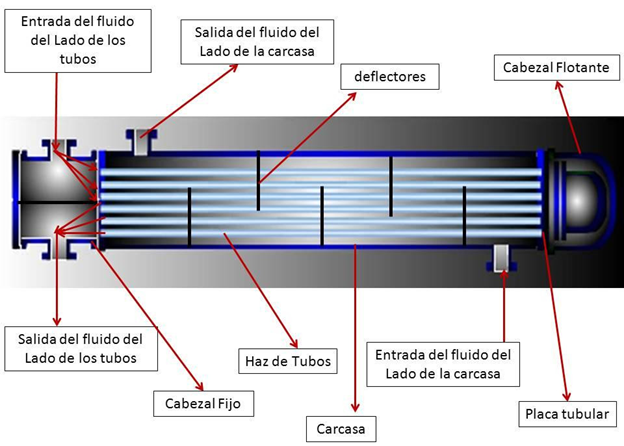
Figure 4: Shell-and-tube heat exchanger
The separated water still contains useful thermal energy. To recover it, a shell-and-tube heat exchanger (Figure 4) can be used. In this system, the hot water flows through either the tubes or the shell, while the other water circuit — the one we want to heat — flows on the opposite side. Heat is transferred through the tube walls without mixing the fluids, efficiently heating a second water loop for other uses in the plant. Once the heat has been extracted, this water reaches the heat exchanger through a return line to repeat its cycle.
Water Make-Up and Conclusion
Finally, we have the water make-up systems. The system described operates as an open cycle, meaning that the steam used in the industrial process cannot be condensed and reused. Therefore, the system must be continuously supplied with water to compensate for these losses. Upon entering, the water is pressurized to reach the 40 bar at which the system operates. It then enters a supply tank, where it waits until it is ready to enter the solar field.
This is how renewable solar thermal energy can be integrated into industrial heat consumption when heat is required at temperatures below 250°C. The same solar fields can reach up to 425°C with modifications to the thermal energy storage system and working fluid. The industry can be in the food, textile, chemical, paper, or any other sector requiring heat.
At FersiSolar, we know how to help you decarbonize your industrial heat consumption. The time to act on climate is now, and the solution already exists. Contact us.


