Energy Saving Certificates (CAEs) in Spain: An Economic Driver for Industrial Decarbonization

Why Talk About CAEs Now?
The energy sector is entering an important deployment phase. Energy efficiency and fossil fuel reduction technologies are being applied in industrial environments with measurable results. The next step is to facilitate the implementation of these projects.
Energy Saving Certificates (CAEs) introduce an additional variable into decision-making by assigning a direct economic value to the savings generated. Energy savings are reflected in a reduction in consumption and an associated additional income. This changes the investment analysis, expands the number of viable measures, and improves their profitability.
CAEs are a tool for financing the implementation of industrial projects. This article presents the fundamentals of the system, its application to industrial projects, and FersiSolar’s role in integrating this type of solution.
What Are CAEs?
CAEs represent certified final energy savings, measured in kWh, generated by a specific action. The difference between an initial and a subsequent situation is quantified through Royal Decree 36/2023, verified through the instructions of the assigned standardized measure, and converted into an asset within the system.
One example of the application of CAEs is the transition from natural gas boilers to high-efficiency electric boilers at an industrial plant. This action significantly reduces natural gas consumption and the associated CO₂ emissions. By generating energy savings, the plant can obtain CAEs, which are tradable on the market, thereby providing an additional source of income and promoting economic sustainability. In this way, not only does the project contribute to industrial decarbonization, but it also promotes a responsible commitment to the environment.
The process involves technical validation of the savings through validated calculation methodologies and correction factors, as well as independent verification by an accredited entity. It is subsequently processed through authorized agents and issued by the regional administration, with registration at national level.
Once issued, CAEs can be traded. Energy savings therefore acquire economic value in addition to reducing consumption. This link between technical savings and economic value is what makes the mechanism relevant for industrial projects.
Important clarification: The system measures energy savings, not emissions, although both effects are usually aligned.
Generating Value from Energy Savings
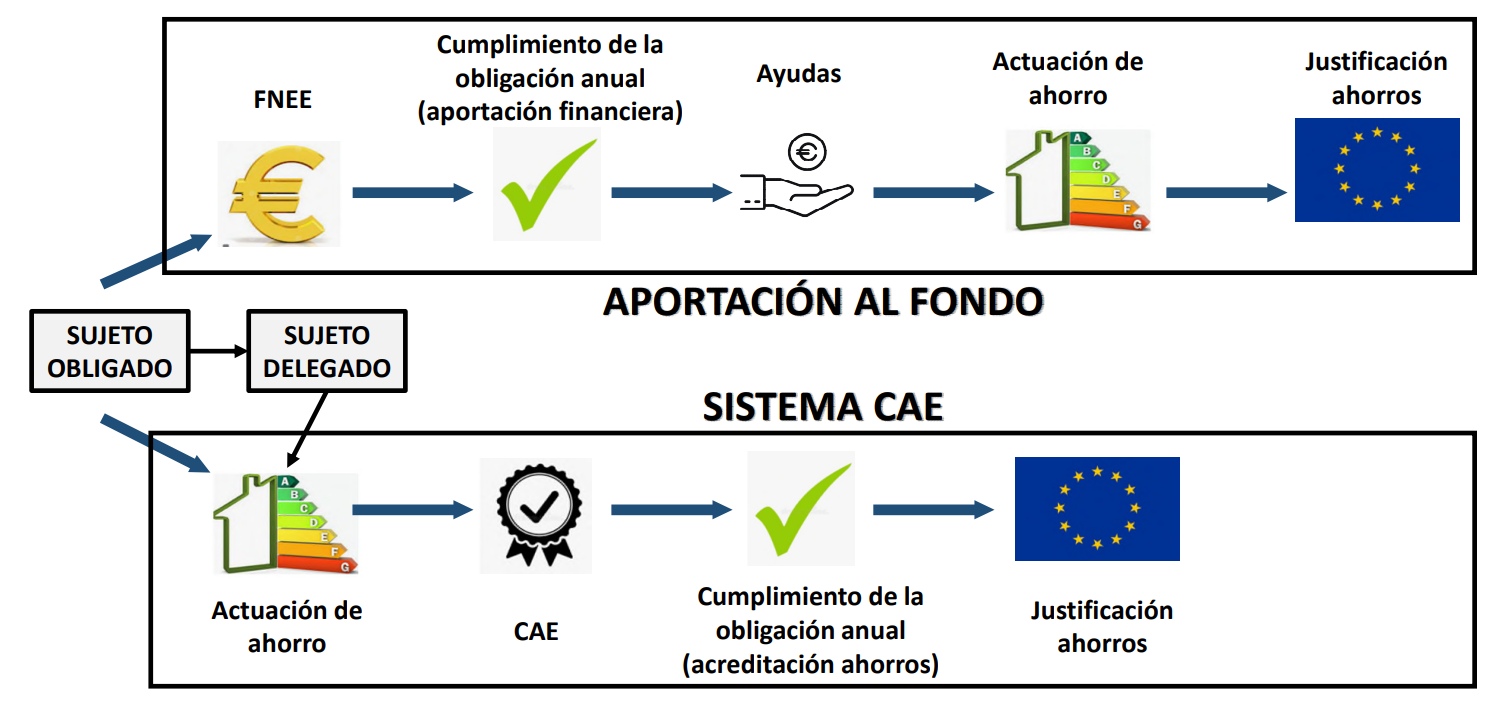
The CAE system is based on a regulatory obligation: energy retailers and suppliers must meet annual energy-saving targets (obligated parties). To do so, they can contribute to the FNEE (National Energy Efficiency Fund) or acquire CAEs generated by projects.
This connects the different stakeholders: a company reduces its consumption, those savings are certified, and they become an asset that other parties need to acquire.
The mechanism follows a simple flow: savings → certification → transfer of value to the project, as shown in Figure 1.
Figure 1. The CAE vs. FNEE process. Source: MITECO
France as a Reference
This approach is already established in reference markets such as France. France has had the CEE (Energy Efficiency Certificates) system since 2005, fully integrated into its energy market. Its adoption in Spain makes it possible to assign value to energy savings within a similarly structured framework.
The system includes standardized measures that simplify implementation and reduce the administrative burden. This facilitates validation and adoption across different sectors. The revenues associated with savings are incorporated into projects from the outset, together with investment and energy savings.
Spain is adopting a model supported by this experience, accelerating its implementation curve.
Spain: Current Status
The CAE system was introduced in 2023 and is currently being deployed. The number of projects is growing and standardized measures are being developed.
Currently, many projects are assessed on a case-by-case basis, particularly in complex industrial environments. In concentrated solar thermal applications, there is still no standardized measure, although proposals are under evaluation.
However, projects can be developed as specific actions, allowing savings to be certified through specific verification. This makes it possible to monetize savings today while the system evolves towards greater standardization.
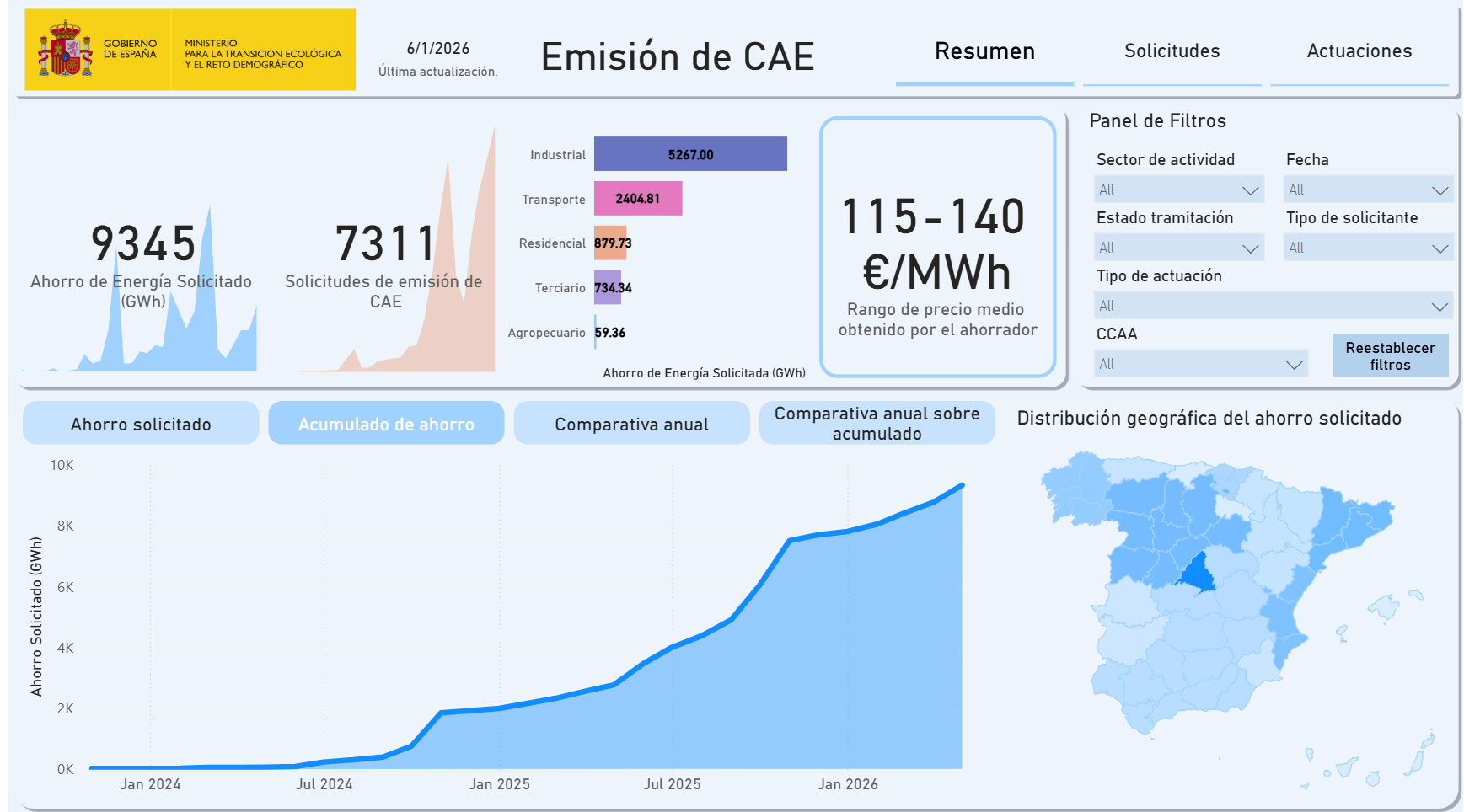
According to Figure 2, approximately 7,311 applications for CAE issuance have been submitted up to 2026, representing total energy savings of 9,345 GWh, of which industry accounts for more than 50%.
Figure 2. Current status of CAE issuance.
The Role of Industrial Heat and Concentrated Solar Thermal Technology
Heat accounts for a significant share of industrial energy consumption, particularly in steam processes and medium- and high-temperature applications. Replacing fossil fuels with concentrated solar thermal technologies makes it possible to directly reduce this consumption. This reduction can be quantified and fits within the CAE system.
This type of action is eligible provided that it results in a reduction in final energy consumption at the facility.
Practical Example: Integration in the Food Industry
To understand how the generation of CAEs can influence the economics of an industrial plant, such as a brewery, dairy facility, or food processing plant, a simplified example is presented below.
Figure 3. Integration of concentrated solar thermal energy into industrial processes. Source: IDEA, 2025.
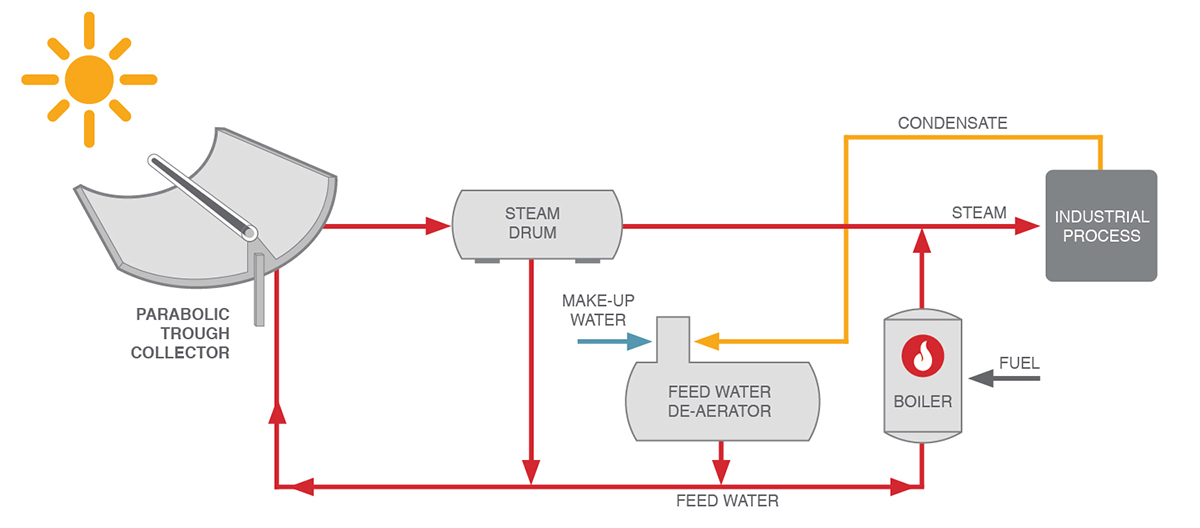
This example can be approximately represented as shown in Figure 3. The plant has a high thermal demand for steam in processes such as cooking or cleaning.
Initial Situation
- Thermal consumption: ~40 GWh/year
- Steam supplied by a gas boiler (~10 MWt)
- The concentrated solar thermal system is integrated into the existing circuit, displacing gas consumption during solar hours, while the boiler acts as backup.
Intervention
- Concentrated solar thermal (~5 MWt)
- Integration with the existing system
- Thermal energy storage
- With ~5 MWt, approximately 25% of annual demand is covered, reducing gas consumption by ~10,000 MWh.
Result
- Solar production: ~10 GWh/year
- Gas reduction: ~25%
- Energy savings: ~10,000 MWh/year
These savings can be certified as CAEs, subject to the baseline, operating conditions, and verification.
CAEs Generated
- ~10,000 CAEs
The associated income is incorporated into the project’s economic model, improving its viability.
Economic Value
- Indicative market price: ~€115–140/MWh
- Revenue: €1.15–1.40 million
How FersiSolar Fits In
FersiSolar designs and integrates concentrated solar thermal systems adapted to industrial processes, including generation, integration, and storage. The result is a measurable reduction in fossil fuel consumption that may be eligible for certification as CAEs.
In addition, project preparation from the outset includes defining the baseline, identifying savings, and structuring the project for verification in accordance with the guidelines of Royal Decree 36/2023.
This approach not only contributes to industrial decarbonization, but also improves the company’s economic sustainability by diversifying its sources of income and reducing operating costs in the long term.
The Current Market Reality
Energy efficiency solutions are already deployed in industry and operate under real service conditions. Projects combine investment, operation, and energy savings, increasingly incorporating revenues associated with CAEs. The CAE system adds a mechanism that connects these savings with the market and allows them to be assigned economic value.
Its development is progressing, with verification and standardization processes gradually maturing, particularly in complex industrial applications. This makes it possible to structure projects more robustly as the system evolves.
At FersiSolar, we firmly believe that what is good for the planet can also be good for business. We are excited to see environmental improvements becoming increasingly profitable.


