Renewables as Industrial Development Lever in Fossil Importing Economies

How Does Energy Dependence Affect Industrial Development?
Energy dependence impacts development because it raises the cost and volatility of a fundamental economic input. Fossil fuel importing economies are exposed to global price cycles, exchange rate passthrough, and geopolitical disruption that lie largely outside domestic policy control. This exposure has direct fiscal and macroeconomic consequences.
Energy dependence also shapes productive investment and industrial competitiveness. Energy is a core input for transport, electricity, and thermal energy demand, which remains one of the least decarbonized components of final energy use globally. High and volatile energy costs increase operating uncertainty for industrial activities, particularly in sectors dependent on continuous thermal processes, and can delay long-term capital investment. International Energy Agency (IEA) analysis shows that energy costs are a key determinant of industrial competitiveness, particularly in energy-intensive sectors, where exposure to high and volatile energy prices can influence production location and long-term investment decisions.
International Monetary Fund (IMF) analysis further links fossil fuel import dependence to balance of payments pressure, inflation vulnerability, and reduced macroeconomic resilience, particularly during periods of global price volatility or geopolitical stress. These dynamics are especially binding for countries with limited fiscal space and shallow capital markets, reinforcing constraints on investment conditions.
The United Nations Industrial Development Organization (UNIDO) highlights that energy cost instability disproportionately affects manufacturing sectors, slowing structural transformation and limiting competitiveness in global markets. UNIDO further highlights that access to reliable and affordable energy is closely linked to industrial upgrading and productivity gains, reinforcing its role as a prerequisite for structural transformation.
This evidence links fossil fuel import dependence to greater uncertainty, higher production costs, and constraints on long-term industrial and fiscal planning.
Can the Energy Transition Reduce These Economic Constraints?
The energy transition in industry can reduce some of these external constraints on development.
UNIDO also identifies the energy transition as an opportunity for industrial development, enabling countries to build new capabilities and avoid long-term lock-ins to higher-cost, fossil-dependent systems.
Substituting imported fossil fuels with domestically available renewable energy lowers exposure to global fuel markets and shifts spending from fuel imports toward local investment. Analysis shows that replacing imported fossil fuels in current energy needs with existing renewable energy technologies could reduce net fossil fuel imports by around 70%, representing potential global savings of over USD 1 trillion per year for importing economies.
The International Energy Agency (IEA) similarly finds that renewable energy deployment reduces sensitivity to fuel price shocks, especially in net importing regions. These benefits materialize regardless of a country’s position in fossil fuel markets.
The energy transition can therefore reduce chronic external vulnerabilities without requiring fundamental changes in global fossil fuel markets.
The main constraint is not technological availability. Renewable power and renewable solutions for industrial heat are already deployed across multiple markets and applications; what limits their adoption at scale in developing and emerging economies is the cost of capital, perceived risk, and project bankability rather than technical feasibility.
Where Is the Opportunity for Domestic Renewable Energy Greatest?
Fossil fuels are concentrated in a limited number of countries, while renewable resources, particularly solar, are widely distributed.
Analysis shows that 92% of the world’s population lives in countries with renewable resource potential exceeding ten times their current energy demand, meaning that, in principle, they could cover both present and future energy needs domestically.
Figure 1: Renewable Energy Potential Relative to National Energy Demand (2022)
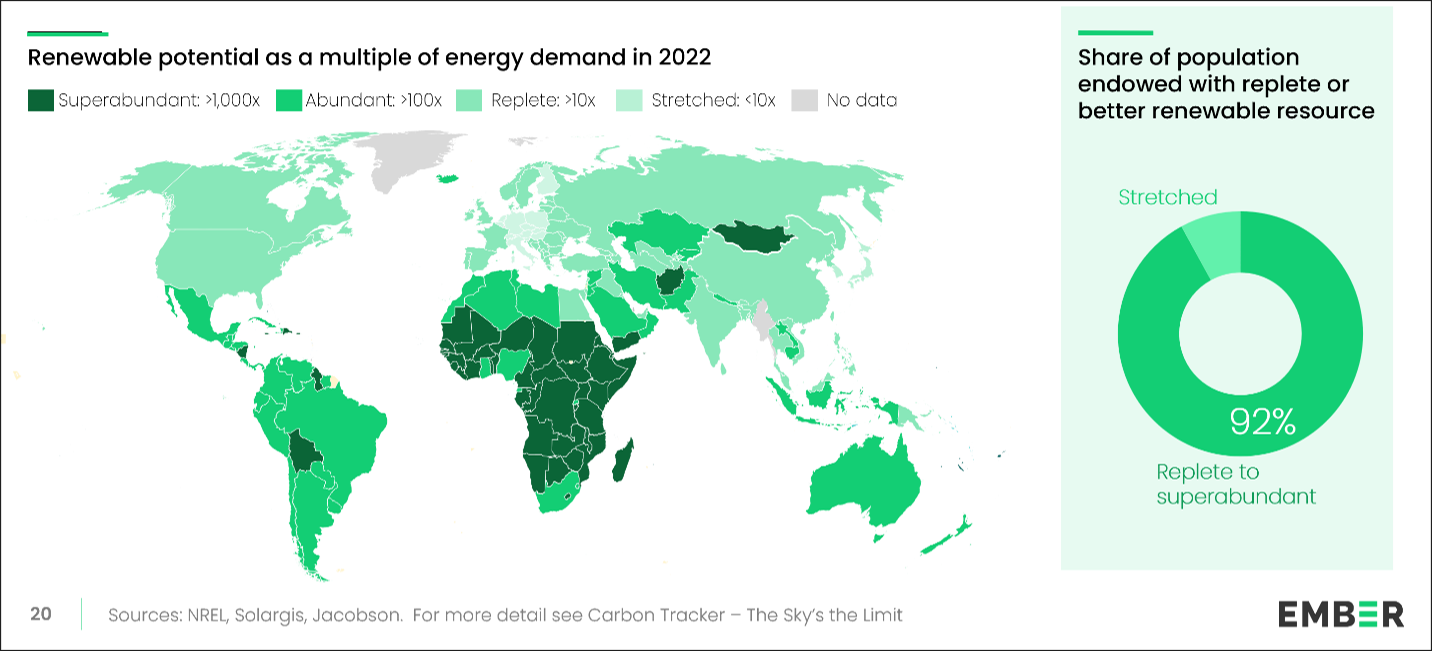
Many economies across Africa, Latin America, and parts of Asia fall into this category: high reliance on imported fuels for electricity, transport, and thermal energy use, coupled with strong solar resource availability. Independent datasets corroborate this mismatch between renewable endowment and current energy mix, indicating that underutilization is driven more by financing and institutional constraints than by physical limits.
What Role Can Concentrated Solar Thermal (CST) Play in Reducing Fossil Fuel Dependence?
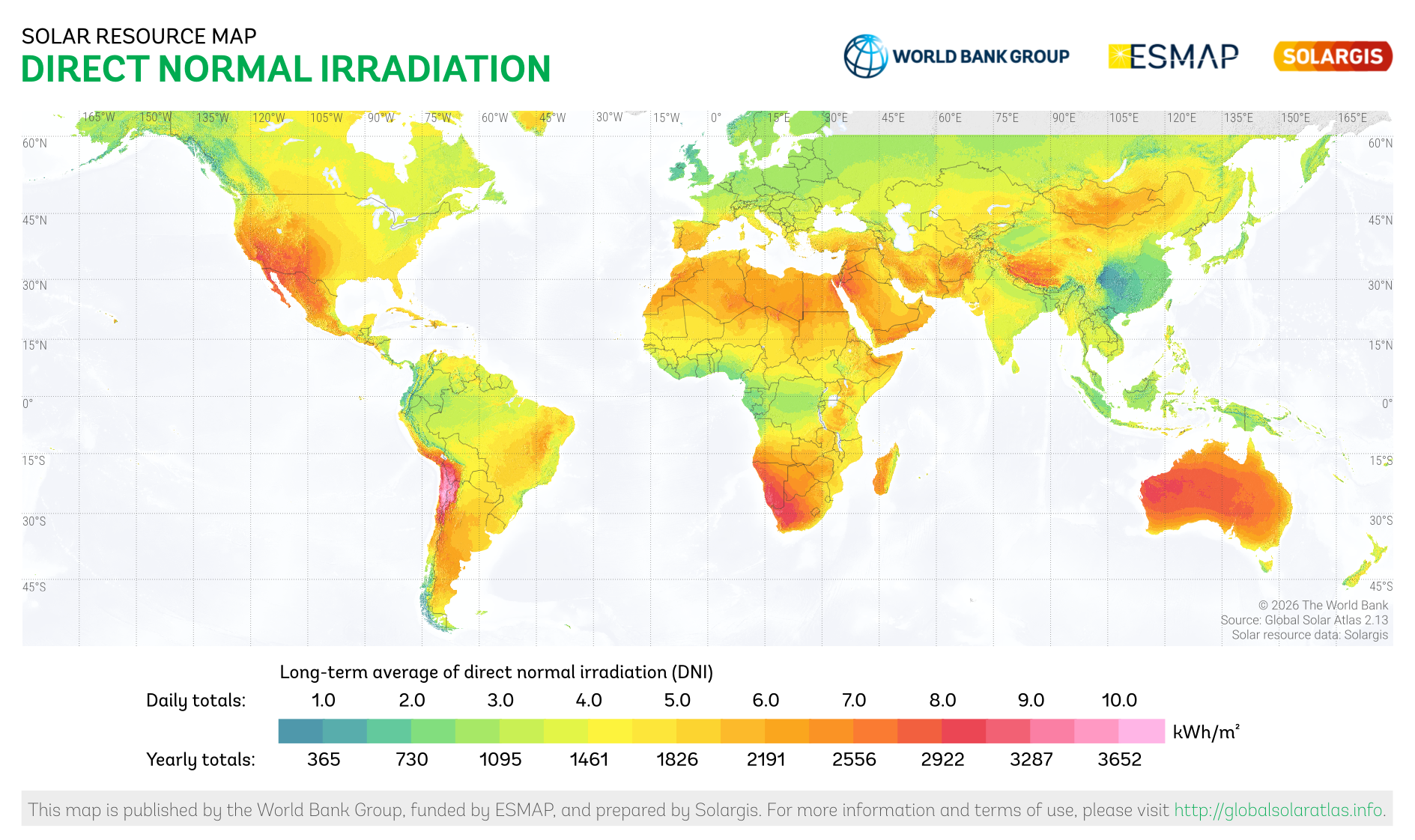
The potential for concentrated solar thermal (CST) is not limited to the sunniest regions. A 2025 Fraunhofer ISE study found that solar thermal systems, including parabolic trough collectors, can provide competitive industrial heat even in Germany, where direct solar irradiation is relatively modest. The results depend on system design, energy prices and available investment support.
For countries with stronger solar resources and high dependence on imported fuels, CST is therefore worth considering as a source of domestic industrial heat. Actual competitiveness must be assessed project by project, considering direct normal irradiation (DNI), industrial heat demand and local energy costs.
For these countries, renewable thermal energy for industry offers an opportunity to reduce dependence on imported fossil fuels, limit exposure to volatile energy prices, and strengthen industrial competitiveness.
Figure 2: Direct Normal Irradiation map. Solar resource map © 2021 Solargis.
What Financing Support Is Available for the Energy Transition?
European Financing: Global Gateway and EFSD+
Current initiatives support the energy transition in fossil-importing economies, particularly in developing regions across Africa, Latin America, and neighboring markets, with an emphasis on risk sharing and private capital mobilization.
The European Union’s Global Gateway strategy, with a global focus on partner countries, frames renewable energy and energy infrastructure investments as strategic assets to enhance economic resilience and reduce dependency on imported fuels, with projects spanning electricity, grids, storage, and renewable heat. Within this framework, the European Fund for Sustainable Development Plus (EFSD+) provides guarantees and blended finance instruments to lower risk and attract private investment in clean energy projects where financing barriers remain high.
The European Investment Bank (EIB), alongside national development finance institutions such as Germany’s Kreditanstalt für Wiederaufbau (KfW) and France’s Agence Française de Développement (AFD), increasingly supports renewable energy projects in developing and emerging economies that displace imported fuels across multiple end uses, including electricity and thermal energy, through concessional loans, guarantees, and technical assistance.
Multilateral Financing: CTF and NAMA Facility
These initiatives build on earlier multilaterally coordinated programs designed to address the financing and risk barriers associated with reducing fossil fuel dependence through clean energy deployment.
The Clean Technology Fund (CTF), established under the Climate Investment Funds and implemented through multilateral development banks, provides concessional finance to accelerate the deployment of low carbon technologies in developing economies, explicitly aiming to displace fossil fuel use through scale and learning effects. Similarly, the Nationally Appropriate Mitigation Actions (NAMA) Facility, funded by Germany, the United Kingdom, Denmark, and the European Union and implemented across Africa, Latin America, and Asia, supported country-driven initiatives that linked emissions reductions with structural economic transformation, moving from isolated pilot projects toward system-level change.
This sample shows how these programs treat reduced fossil fuel dependence as an economic and development objective, while progressively shifting from public funding toward blended finance and private investment mobilization.
What Is Needed to Turn Renewable Potential into Investment?
In economies that depend on fossil imports, energy dependence raises costs and exposure to external shocks. The energy transition offers a pathway to reduce that exposure by replacing imported fuels with domestic renewable energy resources.
Where countries combine high import dependence for actual energy use with abundant solar resources, there is significant potential to reduce vulnerability while strengthening energy independence. How this potential translates into outcomes depends largely on financing conditions and institutional capacity – factors that existing programs explicitly seek to address.
The technologies required are already deployed, demonstrated, and commercially available across multiple applications and markets, but financing and deployment at scale remain the challenge.
About FersiSolar
At FersiSolar, our work supports the deployment, integration, and performance of concentrated solar thermal technologies in global projects. Through engineering, consulting, and operational support, we engage with asset owners, operators, and financial actors across different markets to provide renewable thermal energy for industry. This includes technical services for CSP plants and the development of models for supplying renewable solutions for industrial heat, with the aim of ensuring that available technologies translate into reliable, scalable, and economically viable outcomes.
Sources and references
- Ember (2025) – Energy Security in an Insecure World
- International Monetary Fund (IMF, 2024) – Energy Security and the Green Transition
- International Energy Agency (IEA, 2025) – Gaining an Edge: Energy Demand and Competitiveness
- United Nations Industrial Development Organization (UNIDO, 2024) – Industrial Development Report 2024
- Network for Greening the Financial System (NGFS, 2023) – Scaling Up Blended Finance for Climate Mitigation and Adaptation in EMDEs
- Our World in Data – Energy Imports and Exports (% of Energy Use)
- European Commission – Global Gateway / EFSD+ – Green Energy for Africa and Asia (KfW/DEG)
- Climate Investment Funds (CIF) – Clean Technology Fund (CTF)
- Mitigation Action Facility (formerly NAMA Facility) – Our Story


