

HCEs degradation; observation from a power plant

We recently completed an exhaustive inspection and technical evaluation campaign at a Concentrating Solar Power (CSP) plant, specifically focusing on the Heat Collecting Elements (HCEs). These components are, without a doubt, the core of the Parabolic Trough Collector (PTC) technology, and their performance defines the economic and operational efficiency of the entire power station. The evaluation, which covered various Solar Collector Assemblies (SCAs), allowed for the collection of a vast amount of operational and diagnostic data in the field.
The primary objective of this campaign was to compare the performance between HCEs supplied by different manufacturers, analyzing key variables such as physical condition, thermal stability, and, fundamentally, the critical metric that reflects the element’s vacuum status. The findings have been revealing.
Of all the components analyzed, the HCEs from the manufacturer Hiuyin distinguished themselves by exhibiting the best overall performance. Their superiority was not coincidental; it manifested through excellent visual condition (minimal signs of corrosion or material degradation), but in their exceptional behavior regarding the normalization temperature metric and the resulting thermal efficiency.
The Essence of the HCE: Why Vacuum is Key
To understand the importance of the performance metric, it is essential to grasp the function of the HCE. An HCE consists of an inner absorber tube, through which the Heat Transfer Fluid (HTF) circulates, surrounded by an outer glass envelope. The annular space between the two tubes is evacuated to an extremely high vacuum level (typically in the range of to mbar).
This vacuum chamber plays a vital role: eliminating heat transfer by convection and conduction from the hot absorber tube to the ambient surroundings. Without the vacuum, the glass tube would act as a simple insulator, and the captured thermal energy would be rapidly lost to the atmosphere, drastically reducing the HTF temperature and, consequently, the power generated in the Rankine cycle (or any other power cycle).
In addition to the vacuum, the absorber tube is coated with a selective layer, designed to have high solar radiation absorption (α = 0.95) and low thermal emissivity (Ɛ = 0.10). The combination of the selective layer (which minimizes outgoing radiation) and the vacuum (which eliminates convection/conduction) is what allows the HCE to reach and maintain such high operational temperatures, often exceeding 350ºC.
The Evaluation Metric: A Direct Indicator of HCE Health
The performance metric referenced in the evaluation, which relates to «normalization temperature behavior» and vacuum status, is perhaps the most valuable and sensitive health indicator of an HCE. As mentioned, this metric is a measure of the Heat Loss from the absorber, normalized or compared under standardized operational conditions.

Key Variables:
- is the ambient temperature in ºC in the minute the measurement was taken.
- is the HTF temperature in ºC in the minute the measurement was taken.
- is the average temperature in ºC of all observations for the particular HCE in the minute the measurement was taken.
Interpretation of the Metric: Vacuum Diagnosis
The final value of this metric is interpreted as follows:
- Stable and Negative Values: These indicate a well-preserved vacuum condition ( < 0 or similar). This means the measured heat loss (represented by ) is below or very close to the optimal reference value (corresponding to a perfect vacuum).
- Values Near Zero or Positive: These signal a significant loss of vacuum (≥ 0). When the vacuum degrades, the residual gas begins to conduct and convect heat out of the absorber, increasing the loss. This causes the measured value ( or the calculated ) to increase. The result is a notable reduction in efficiency and a lower HTF outlet temperature under the same irradiance.
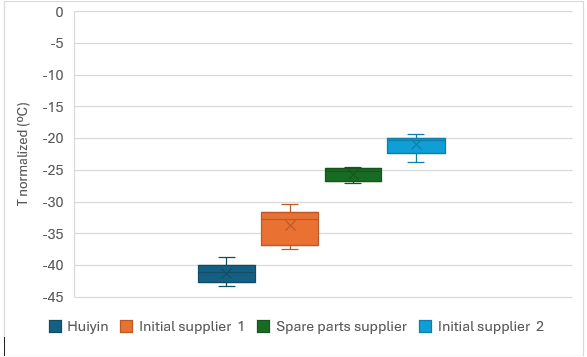
- Considering that both were installed at the same time, the graph clearly shows that Huiyin performs significantly better than other provider.
- Looking at the previous graph, it’s clear that initial supplier 1 performs better than initial supplier 2. It’s surprising, considering they were both installed at the same time.
Re-evacuation.
As we can see, HCEs naturally deteriorate over time, since their internal vacuum gradually decreases and performance drops. However, even the Huiyin receivers offer a very valuable advantage: their re-evacuation capability.
This process makes it possible to restore the vacuum level almost to its original state, and it also allows the getters to be reused. The hydrogen they have accumulated can be removed again through a high-vacuum, high-temperature treatment, and Huiyin has the proper equipment to carry this out. Even better, a getter can be recycled up to about ten times.
This re-evacuation capability is highly beneficial because it allows us to extend the useful life of the HCEs for many more years, maintaining their performance and reducing the need for premature replacements.
- Warranty Validation and Supplier Evaluation
As demonstrated with Hiuyin’s HCEs, this normalized temperature is fundamental for the comparative evaluation of suppliers. It allows owners and operators to:
- Validate Manufacturing Quality: A supplier that consistently produces HCEs that maintain stable negative values for years demonstrates superior quality in materials, the glass-to-metal sealing process, and the final vacuum level. This translates into a lower Levelized Cost of Energy (LCOE) over the long term for the plant.
- Enforce Warranty Clauses: Contractual HCE warranties are often tied to the maximum heat loss rate. If this normalized metric exceeds a predefined threshold within the warranty period, the operator has objective and quantifiable proof to request free replacement from the manufacturer. Even in this field huiyin ofrece una ventaja superior con un periodo de garantía mucho mayor a la del resto de las empresas.
- Plant Performance Optimization
Vacuum loss in a single HCE can have a surprisingly disproportionate impact on the entire collector row. When one HCE fails, it starts taking heat away from the HTF flowing through it, and that drop in outlet temperature forces the control systems to make less efficient choices—sometimes concentrating sunlight more aggressively, other times reducing flow just to compensate. And honestly, none of that helps.
This metric ensures that the plant operates with as many collectors as possible under their optimal design conditions. When all HCEs maintain negative normalized loss values, the solar field efficiency stays at its peak. The outcome is clear and genuinely valuable: higher operating income and, just as importantly, greater clean energy generation.


